In trading, profits often get all the attention. New traders obsess over strategies, indicators, and market predictions, believing that the right setup will unlock consistent gains. Yet when you look at how professional traders and proprietary trading firms actually operate, one thing stands out: risk management matters more than any strategy.
Risk management is not about avoiding losses altogether. Losses are inevitable. Instead, it’s about controlling how much you lose, how often you lose, and how those losses impact your trading capital over time. In prop trading especially, where strict drawdown rules and capital limits apply, poor risk management is the fastest way to fail an evaluation even with a solid trading edge.
This article breaks down risk management in trading from a professional perspective. We’ll explore what it really means, why it’s critical in prop trading, and how traders can apply practical risk controls without overcomplicating their process.
- What Is Risk Management in Trading?
- Why Risk Management Is Critical in Prop Trading
- The Relationship Between Risk and Reward
- Position Sizing: The Core of Risk Control
- Stop-Losses: A Tool, Not a Punishment
- Managing Drawdowns Like a Professional
- Psychological Risk: The Invisible Threat
- Risk Management vs. Strategy: What Matters More?
- Risk Management in Different Market Conditions
- Common Risk Management Mistakes Traders Make
- Building a Personal Risk Management Framework
- Key Takeaways
- FAQ
What Is Risk Management in Trading?
At its core, risk management is the process of identifying, measuring, and controlling potential losses in trading. It answers one simple question before every trade:
“How much am I willing to lose if this trade doesn’t work?”
In practice, risk management includes position sizing, stop-loss placement, drawdown limits, diversification, and emotional discipline. It is not a single rule but a framework that governs every trading decision.
Professional traders treat risk as a variable they can control. They understand that markets are unpredictable, but exposure is not. A trader who risks too much on one trade may wipe out weeks of progress in minutes. A trader who manages risk properly can survive a losing streak and stay in the game long enough for their edge to play out.
Why Risk Management Is Critical in Prop Trading
Risk management becomes even more important in proprietary trading than in personal retail accounts. Prop firms provide traders with access to large amounts of capital, but that access comes with strict rules.
Most prop trading firms impose:
- Maximum daily loss limits
- Overall drawdown thresholds
- Position size restrictions
- Mandatory stop-loss rules
Violating these rules, even once, often means losing the funded account.
A trader might have a profitable strategy over 100 trades, but if they breach a drawdown limit in the first week, the evaluation ends immediately. This is why many skilled traders fail prop firm challenges not because their strategy is bad, but because their risk management is incompatible with the firm’s rules.
In prop trading, capital preservation is not optional. It’s a requirement.
The Relationship Between Risk and Reward
One of the most misunderstood concepts in trading is the risk-to-reward ratio. Many beginners assume that higher rewards require higher risk. In reality, professional traders aim for the opposite: controlled risk with asymmetric upside.
Risk-to-reward refers to how much a trader is willing to lose relative to how much they expect to gain. For example:
- Risking $100 to make $300 is a 1:3 ratio
- Risking $200 to make $200 is a 1:1 ratio
A trader with a 1:3 risk-to-reward ratio can be profitable even if they win fewer than half their trades. This is a powerful concept, especially in prop trading, where consistency matters more than win rate.
Risk management is not about maximizing profits on each trade. It’s about ensuring that no single loss or series of losses can cause irreversible damage to the account.
Position Sizing: The Core of Risk Control
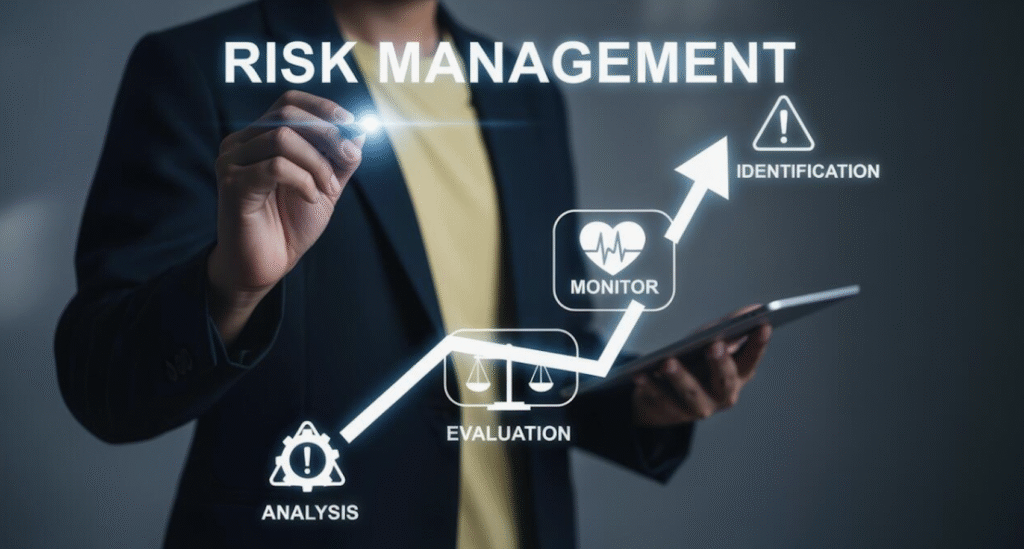
Position sizing is arguably the most important risk management tool available to traders. It determines how much capital is allocated to a single trade.
Rather than thinking in terms of lot size or number of contracts, professional traders think in terms of percentage risk. For example:
- Risking 0.5% of account equity per trade
- Risking 1% on high-confidence setups
- Reducing risk after a drawdown
This approach keeps losses proportional, regardless of account size. Whether a trader is managing a $10,000 account or a $200,000 prop account, percentage-based risk keeps emotions in check and performance consistent.
Poor position sizing is one of the main reasons traders blow accounts. Even a strong setup can fail, and if the position is too large, the damage is immediate.
Stop-Losses: A Tool, Not a Punishment
Many traders view stop-losses as a necessary evil or something to be avoided. In reality, a stop-loss is simply the point where a trade idea is proven wrong.
A well-placed stop-loss:
- Defines risk before entering a trade
- Prevents emotional decision-making
- Protects capital during high volatility
Professional traders place stops based on market structure, not arbitrary numbers. A stop placed just to limit loss, without regard for price behavior, often gets hit unnecessarily.
In prop trading environments, stop-loss discipline is non-negotiable. Traders who move or remove stops frequently violate firm rules or accumulate losses faster than expected.
Managing Drawdowns Like a Professional
Drawdowns are part of every trading career. What separates professionals from amateurs is how they respond to them.
Effective drawdown management includes:
- Reducing position size after consecutive losses
- Taking breaks during emotional stress
- Reviewing trades objectively rather than chasing losses
In prop trading, drawdown limits are fixed. Traders must adapt their risk to ensure they stay well below these thresholds. A trader who ignores drawdown management often enters a cycle of overtrading and revenge trading, accelerating failure.
Experienced traders treat drawdowns as feedback, not failure. They adjust exposure, not their entire strategy, unless data supports a deeper issue.
Psychological Risk: The Invisible Threat
Risk management isn’t only about numbers. Psychological risk plays a major role in trading outcomes.
Fear, greed, and overconfidence can distort decision-making, leading traders to:
- Increase risk impulsively
- Skip valid setups
- Hold losing trades too long
Professional traders build rules that protect them from themselves. Fixed risk per trade, daily loss limits, and predefined trading hours reduce emotional interference.
In prop trading, psychological discipline is often tested more than technical skill. Knowing that one mistake can end an evaluation amplifies emotional pressure, making structured risk management essential.
Risk Management vs. Strategy: What Matters More?
A common question among traders is whether strategy or risk management is more important. The honest answer is that a mediocre strategy with excellent risk management often outperforms a great strategy with poor risk control.
Risk management determines:
- How long you survive in the market
- How consistent your equity curve is
- Whether your edge has time to manifest
Many profitable traders use relatively simple strategies. What makes them successful is not complexity, but consistency in execution and strict control of downside risk.
Risk Management in Different Market Conditions
Markets change. Volatility expands and contracts, liquidity shifts, and correlations break down. Risk management must adapt accordingly.
During high volatility:
- Position sizes should be reduced
- Stops may need to be wider but risk remains fixed
- Fewer trades are often better
During low volatility:
- Tight risk control prevents overtrading
- Expectations for profit targets should adjust
Prop traders who fail to adapt risk to market conditions often experience sudden drawdowns, even when their strategy logic remains sound.
Common Risk Management Mistakes Traders Make
Even experienced traders fall into predictable risk traps. Some of the most common include risking more after losses, ignoring correlation between trades, and increasing size too quickly after a winning streak.
Another frequent mistake is focusing on daily profits instead of long-term expectancy. Risk management works best when viewed over a large sample of trades, not isolated outcomes.
Successful traders think in probabilities, not certainties.
Building a Personal Risk Management Framework
There is no universal risk management model that works for everyone. Each trader must build a framework aligned with their personality, strategy, and prop firm rules.
A solid framework typically includes:
- Maximum risk per trade
- Daily and weekly loss limits
- Rules for reducing risk during drawdowns
- Clear criteria for increasing size
The key is consistency. A risk plan that is followed 80% of the time is not a plan it’s a suggestion.
Key Takeaways
Risk management is the foundation of long-term trading success, especially in prop trading environments. Strategies come and go, markets evolve, but disciplined risk control keeps traders in the game.
Professional traders don’t aim to avoid losses. They aim to control them. By managing position size, respecting drawdown limits, and maintaining psychological discipline, traders create the conditions for consistent profitability.
In trading, survival is success and risk management is how you survive.
FAQ
What is the most important risk management rule in trading?
Limiting risk per trade. If you control how much you lose, you control your longevity in the market.How much should I risk per trade in prop trading?
Most professional traders risk between 0.25% and 1% of account equity per trade, depending on firm rules and strategy.Can a trader be profitable with a low win rate?
Yes. With proper risk-to-reward ratios, traders can be profitable even with win rates below 50%.Why do prop traders fail evaluations so often?
Most failures are due to poor risk management, not bad strategies especially violations of drawdown rules.Is risk management more important than strategy?
In practice, yes. A solid risk framework can make an average strategy profitable over time.